
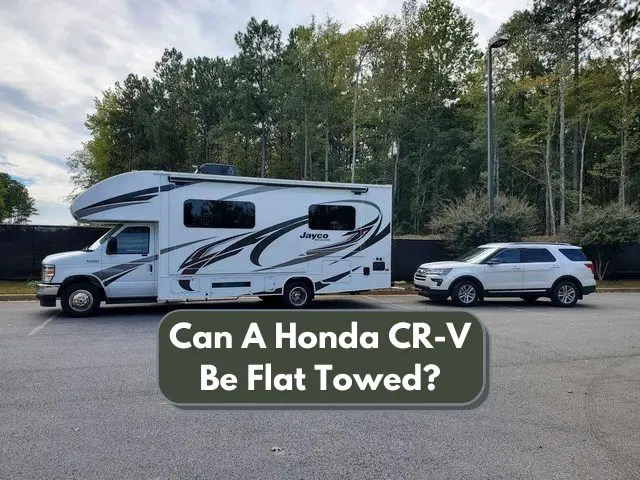
If you’ll be hitting the road in your RV, motorhome, or other tow vehicle but want to bring your smaller vehicle along, you’re probably wondering: can a Honda CRV be flat towed?
Yes, a Honda CRV can be flat towed as long as you have the proper towing equipment on both vehicles and your RV can tow up to 3,569 lbs.
Can You Flat Tow Honda CRV?
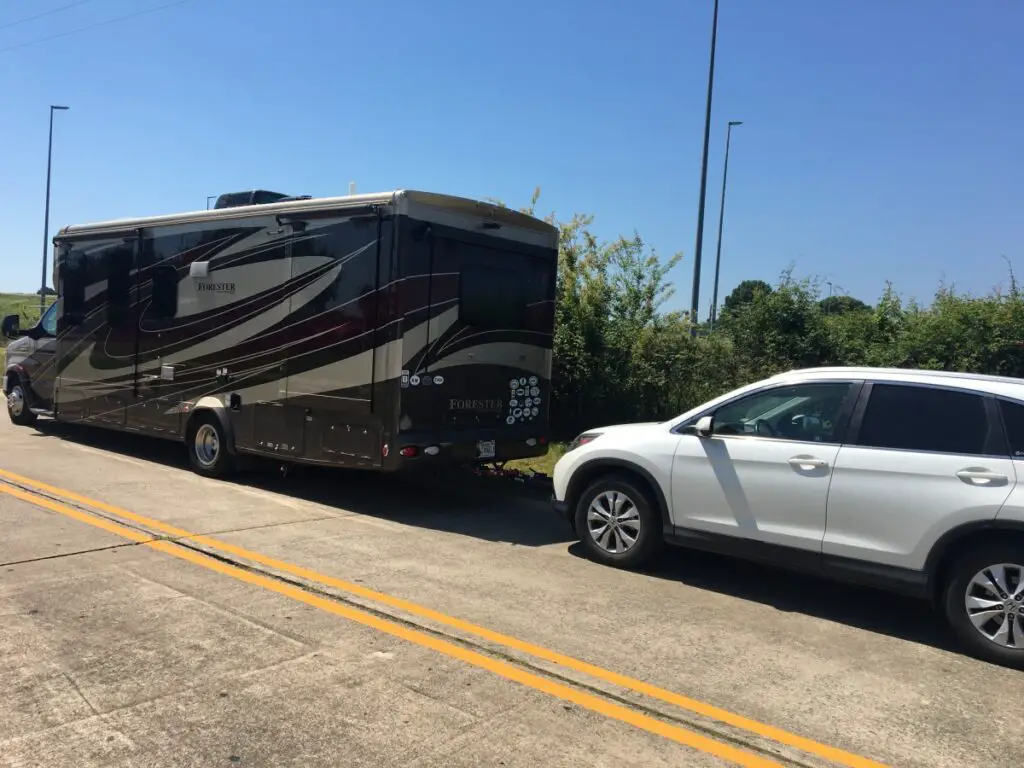
You can flat tow a Honda CRV as long as you have the right equipment and your vehicle is able to tow the weight of the Honda CRV, which is 3,569 lbs.
Not all vehicles can be flat towed, so it’s important to make sure you have as much information as possible to prepare for flat towing your Honda CRV.
What Is Flat Towing?
Flat towing (also called “four-down towing” or “dinghy towing”) is a method of towing your vehicle where it has all four tires touching the ground.
Benefits Of Flat Towing A Honda CRV
- Flat towing your Honda CRV has some key benefits versus other towing methods:
- It only takes one person to hook up a Honda CRV for a flat tow.
- The towing equipment is more affordable than a vehicle dolly or flat trailer.
- Most vehicles can be flat towed, including the Honda CRV.
- No extra insurance to carry on a trailer since there’s no trailer involved.
- Flat towing is lighter and more energy efficient, putting less wear on your RV or tow vehicle.
- Flat towing is easier to maneuver through parking lots, back roads, and parking lots.
How To Flat Tow Honda CRV
- Park on a level surface
- Check the height between your RV’s hitch and the Honda CRV’s base plate
- Mount the tow bar on your RV
- Park the Honda CRV behind the RV
- Attach the tow bar arms
- Prep the Honda CRV for flat towing by setting the transmission for towing and unlocking the the steering wheel
- Engage the tow bar latches
- Attach safety tables
- Plug in wiring harness
- Confirm the tow bar arms are locked and check the lighting to make sure everything works
Once you’re at your location, follow these steps:
- Park on a level surface.
- Disconnect the safety cables and wiring harness.
- Release the tow bar arms.
Flat Tow Honda CRV: What You’ll Need
Honda CRV Base Plate Kit
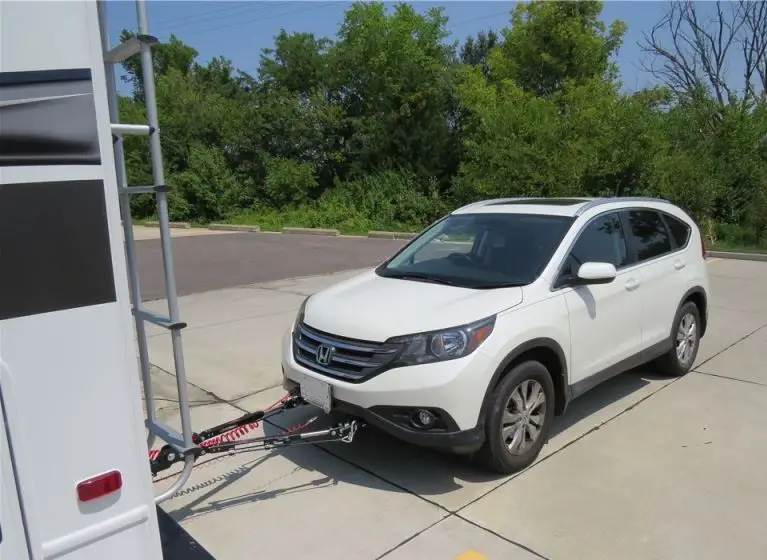
A base plate kit is a set of steel components installed on the front frame of your Honda CRV, with connection points to attach a tow bar to it.
The other end of the tow bar attaches to the tow hitch on your RV.
Honda CRV Base Plate Kit Cost
The average price of a base plate kit for flat towing a Honda CRV costs between $450-$700.
Here’s a recommended base plate kit for most Honda CRV years:
No products found.
Honda CRV Base Plate Installation Cost
It can run between $200-$500 to have a base plate for a tow bar installed on a Honda CRV depending on the difficulty of the install.
Honda CRV Base Plate Installation
Here’s a video showing you how to install a base plate kit for flat towing a Honda CRV:
Honda CRV Tow Bar
The tow bar links your Honda CRV to your RV’s tow hitch so it can be flat towed.
They can be vehicle-mounted or RV-mounted, and there are several material options and other variables like fixed or telescoping arms to consider when selecting a tow bar.
The main thing to consider when choosing a tow bar for your Honda CRV is to ensure it’s compatible with the base plate kit.
Safety Cables
Safety cables connect your Honda CRV to your towing vehicle and acts as a backup in case your tow bar fails and ensures that both vehicles stay connected.
Flat tow safety cables typically run between $45 and $75 for a quality set.
Check out these safety cables for flat-towing a Honda CRV:
No products found.
Set Up A Supplemental Or Auxiliary Braking System
A supplemental braking system syncs your RV’s brakes with your Honda CRV’s brakes and is required in most U.S. states and Canadian provinces and allows you to safely flat tow your Honda CRV with an RV.
An auxiliary braking system can decrease braking distance by up to 30% on most towing setups and helps to minimize wear on both your RV and Honda CRV while allowing smoother braking.
There are two types of supplemental braking systems:
Fixed braking systems are installed one-time and you don’t have to remove it after flat towing a Honda CRV behind your RV. They may require professional installation.
Portable braking systems are easier to install yourself, but need to be removed and set up again each time you perform Honda CRV flat towing.
Tow Bar Wiring
You need to have a lighting system on your Honda CRV that syncs with your RV’s tail lights to comply with state laws while flat towing your vehicle.
A tow bar wiring kit makes sure that your Honda CRV’s lights sync with your RV when braking, using the turn signal, or putting on your hazards.
There are several different tow bar wiring options:
- Removable exterior light kits are magnetic, easy to install, and are the most affordable option.
No products found.
- Bulb and socket kits mount inside your Honda CRV’s tail light housings and bypass the lighting system, but they can be a hassle to install.
No products found.
- Diode kits wire in with your vehicle’s existing tail lights, and is the most common tow bar wiring option. Once it’s installed, you don’t need to set it up or remove it ever again, and uses your vehicles existing bulbs.
- Custom-fit plug-in wiring harnesses plug directly into your Honda CRV’s tail light wiring harness and works the same as a diode kit, but can be easier to install.
Charge Line Kit
Since your Honda CRV is technically “on” while flat towing, the battery can drain if it’s not being actively charged.
A charge line kit connects to a 6-way or 7-way plug and allows your RV to charge your vehicles battery while it’s being flat towed, preventing a dead battery on your Honda CRV once you reach your destination.
RV Tow Hitch
While it may seem obvious, you’re going to need a tow hitch on your RV to tow anything.
Refer to your RV’s owner’s manual or online resources to find and install an RV tow hitch if you need one.
Flat Towing A Honda CRV: Precautions To Take
Find Your RV’s Hitch Weight Capacity
You’ll need to take into account the towing capacities of both your hitch and RV (or other tow vehicle) before flat towing a Honda CRV.
Check your RV’s hitch weight capacity to show you how heavy of a vehicle you can tow.
Honda CRV Curb Weight
The Honda CRV weight is 3,569 lbs, so as long as that doesn’t exceed the hitch weight capacity, you’ll be fine to proceed with a Honda CRV flat tow.
If flat towing a different vehicle other than the Honda CRV, check the curb weight of the vehicle to ensure it doesn’t exceed the hitch weight capacity of the tow vehicle.
Find Your RV’s Towing Capacity
Now, check the Gross Combined Weight Rating (GCWR) of your tow vehicle (typically an RV) and subtract the Gross Vehicle Weight Rating (GVWR) from it to find your RV’s towing capacity.
- GCWR – GVWR = Towing Capacity
Make Sure Your Honda CRV’s License Plate Is Visible
Most states will enforce that you have your flat-towed vehicle’s license plate visible, so make sure you do this to avoid any tickets.
Don’t Tow A Disabled Vehicle
If your vehicle is not operational or has mechanical issues, then you shouldn’t flat tow a Honda CRV.
Use a flatbed tow truck or flatbed trailer instead.
Use Level Ground
Always hook up and disconnect your vehicle on ground that’s as level as possible when flat towing.
Do A Final Check Before Heading Out
Always make sure that your tow bar arms are locked in place and that your lights are functioning correctly before hitting the road and flat towing your Honda CRV behind your RV or other tow vehicle.
What Year Honda CRV Can Be Flat Towed?
You can tow most year models of Honda CRV as long as you don’t exceed the tow hitch weight or tow vehicle’s towing capacity.
Check the curb weight of your specific year Honda CRV to make sure you’re within the proper guidelines.
Can A 2019 Honda CRV Be Flat Towed?
Yes, a 2019 Honda CRV can be flat towed as long as you have the right equipment and tow at speeds up to 65 miles per hour.
Can You Flat Tow A Honda CRV AWD?
Yes, a Honda CRV AWD can be flat towed with the proper equipment at up to 65 mph.
Can A Honda CRV Be Towed Behind An RV?
Yes, you can tow a Honda CRV behind an RV as long as you have the proper equipment installed on both vehicles.
Can a Honda CRV Be Towed Behind A Motorhome?
Yes, you can tow a Honda CRV behind a motorhome as long as you have the proper equipment installed on both vehicles.
Does Flat Towing Add Miles To A Honda CRV?
It depends. If your vehicle has an electric odometer and the transmission is turning with the ignition in the “on” position, then flat towing will add miles to your Honda CRV.
If you are able to shift the car into neutral without keeping the ignition on, then it will not add mileage to a vehicle with an electric odometer.
For vehicles with a mechanical odometer (which were mostly phased out around 2000), flat towing will add miles on the odometer.
Should I Flat Tow Honda CRV Facing Forward Or Backward?
You should always flat tow your Honda CRV facing forward.
Will Flat Towing Damage My Honda CRV?
Flat towing your Honda CRV should not cause any damage to it if the proper equipment and precautions are exercised.
The most common damage is going to be cosmetic, like chips in the windshield.
Of course, towing your vehicle will put wear on the tires, but nothing different in terms of wear than you would get from driving the vehicle normally.
Always read your vehicle’s owner manual prior to flat towing it to make sure you use the right settings to avoid mechanical and transmission damage.
Flat Towing Vs Dolly Towing Honda CRV
Dolly towing your Honda CRV is an alternative to flat towing, with the following pros and cons:
Dolly Towing Pros:
- You can dolly tow most front-wheel drive vehicles.
- You can reverse easily while dolly towing (not the case with flat towing).
- No baseplate required.
Dolly Towing Cons:
- Equipment costs more than flat towing.
- Not compatible with all vehicle types.
- Some states require you to insure the dolly trailer or take out additional insurance on the towed vehicle.
Can You Flat Tow A Honda CRV? Wrapping Things Up
We hope this guide helped you to understand that yes, you can flat tow a Honda CRV behind an RV or other tow vehicle, provided you have the proper equipment installed and take the necessary steps to prepare both vehicles for the trip.
Flat towing is quick and convenient, and ensures you have a vehicle to get around in once you get your RV to your destination.
How did your experience go with flat towing your Honda CRV, and what equipment options did you select? Let us know in the comments below.
While you’re here, check out our other helpful RV repair guides:
- What to do if your RV water pump keeps running
- How to perform RV toilet foot pedal repair
- Our guide to RV roof reseal cost
- What to do if your RV heater is blowing cold air
- How to fix an RV microwave not working
- Our guide to motorhome fuel pump replacement
- How to replace RV window glazing bead
- How to fix an RV toilet not holding water
- How to fix a sagging RV slide out
- Preparing for an RV one night freeze